Karoline Leavitt Vanity Fair: The Unretouched Truth Behind America’s Most Talked-About Political Portrait

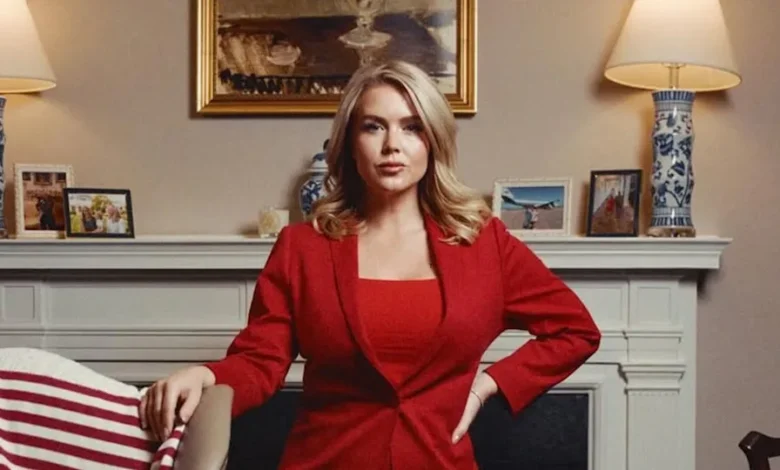
When White House Press Secretary Karoline Leavitt walked into the Vanity Fair photoshoot in November 2025, she probably expected the kind of polished, dignified portrait that typically accompanies a profile of a high-ranking administration official. Instead, what emerged from photographer Christopher Anderson’s lens became one of the most controversial and widely dissected political images of the year. The Karoline Leavitt Vanity Fair photograph—an unflinching, pore-level close-up that appeared to show injection marks on the 28-year-old press secretary’s upper lip—didn’t just capture a face. It captured something far more revealing about the state of American political Karoline Leavitt Vanity Fair discourse, the weaponization of appearance, and the contradictions within modern feminism -1-8.
The image, published as part of a broader feature on the inner workings of Trump’s second administration, sparked a firestorm that transcended the usual left-right skirmishes. Within hours, social media platforms were flooded with reactions ranging from cruel mockery to fierce defense. Conservative commentators accused Vanity Fair of intentionally humiliating Leavitt, while some progressive voices—many of whom would typically champion body positivity—found themselves making comments about the press secretary’s appearance that sounded uncomfortably like the very misogyny they claimed to oppose -1. The controversy forced Americans to confront an uncomfortable Karoline Leavitt Vanity Fair question: In an era of hyper-polarized politics, has a woman’s face become just Karoline Leavitt Vanity Fair another battleground?

But the Karoline Leavitt Vanity Fair saga is about much more Karoline Leavitt Vanity Fair than one photograph. It’s a story about a generation-defining political communicator who rewrote the rules of the White House briefing room. It’s about a 28-year-old mother who Karoline Leavitt Vanity Fair returned to work four days after giving birth because an assassination attempt on her Karoline Leavitt Vanity Fair boss demanded her presence. It’s about the collision between old-media gatekeeping and new-media disruption. And it’s about what happens when the unforgiving glare of modern political coverage meets the even more unforgiving standards we apply to women in power -3-6.
This article dives deep into every angle of the Karoline Leavitt Vanity Fair moment—the photograph that launched a thousand hot takes, the medical questions it raised, the political philosophy it Karoline Leavitt Vanity Fair inadvertently illuminated, and what it all says about where we are as a country. Whether you see Leavitt as a trailblazing conservative voice or a mouthpiece for an administration you oppose, Karoline Leavitt Vanity Fair her story matters. Because the way we talk about women like her reveals more about us than it does about her.
The Photograph That Broke the Internet: Deconstructing the Vanity Fair Image
Let’s start with the image itself, because understanding what actually happened requires looking beyond the memes and the outrage. Christopher Anderson, the veteran photojournalist behind the Karoline Leavitt Vanity Fair portrait, has spent decades building a reputation for unflinching honesty. He’s covered wars, documented refugees, and photographed everyone from Holly Karoline Leavitt Vanity Fairwood stars to world leaders. But his approach to political photography has always been distinct: He doesn’t do glamour. He does truth -8.
Anderson’s process for the Vanity Fair shoot was consistent across all subjects. He Karoline Leavitt Vanity Fair photographed White House Chief of Staff Susie Wiles, Vice President JD Vance, Secretary of State Marco Rubio, and other administration figures Karoline Leavitt Vanity Fair using the same method—extreme close-ups, unretouched, with no effort to smooth over wrinkles, blemishes, or imperfections. The goal, as Anderson explained to multiple outlets, was to “pierce the image politicians want to project on the ‘theater’ of politics and show a more truthful side” -8.
For Leavitt, that meant a frame so tight that every detail Karoline Leavitt Vanity Fair of her skin became visible. The photograph showed what appeared to be small red marks on her upper lip—details that many online observers quickly identified as potential injection sites from recent lip filler procedures. Anderson defended his decision not to retouch the image, telling Newsweek: “Style is for others to judge. My objective, Karoline Leavitt Vanity Fair when photographing the Karoline Leavitt Vanity Fair political world, is to make photographs that cut through the staged-managed image to reveal something more real” -5. He added that he chooses not to “retouch blemishes, injection marks, wrinkles, etc. From my perspective, it should be shocking if I did indeed retouch these things out” -5.
The response was swift and savage. On Instagram alone, the image garnered hundreds of thousands of views and tens of thousands of comments within days. Critics called it “disturbing,” “busted,” and worse. Some progressive accounts, often the same ones that campaign against body-shaming, made jokes about Leavitt “aging poorly” because she had “sold her soul” -1. One man with #Feminist in his bio posted his own zoomed-in face, declaring that “evil ages you.” Another self-described #WokeAF #ProChoice user wrote that she was “obsessed” with the evidence that “hate ages you” -1.
The conservative response was equally intense, though for different reasons. Karoline Leavitt Vanity Fair Republican officials and conservative media figures rallied to Leavitt’s defense, not just against the substance of the photograph but against what they perceived as its intent. US Representative Anna Paulina Luna tweeted: “Karoline Leavitt is stunning! She is arguably one of the prettiest Press secretaries we’ve ever had!” -1. Evie Magazine, a conservative women’s publication, extended an invitation for a do-over photoshoot to “accurately represent [Leavitt’s] beauty” -1.
What’s striking about both sets of reactions is how they centered on Leavitt’s appearance rather than her work. The left-leaning critics, in their rush to mock, deployed the exact same weapon—a woman’s looks—that they typically condemn when conservatives use it. The right-leaning defenders, meanwhile, felt compelled to argue that Leavitt was actually beautiful, as if her political legitimacy depended on winning a beauty pageant -1.
As Boston Globe columnist Zoe Yu observed, the episode revealed a profound hypocrisy: “The two sides finally agree on something: The most devastating insult that we can think of to call a woman is ugly” -1. Yu, a Harvard student, argued that progressives who mock Leavitt’s appearance while claiming to oppose misogyny are engaging in a dangerous contradiction. “When you say that Karoline Leavitt Vanity Fair hate makes a woman age poorly,” she wrote, “you’re also saying that we can make character judgments by looking at a woman’s face. That logic isn’t less dangerous just because it’s deployed in the ‘right’ direction” -1.
The Medical Debate: Lip Filler Rumors and Pregnancy Questions
The Karoline Leavitt Vanity Fair photograph didn’t just spark cultural commentary—it also raised genuine medical questions. The visible marks on Leavitt’s upper lip led to widespread speculation about whether she had received cosmetic injectables, and if so, when. Those questions became significantly more complicated when, just ten days after the Vanity Fair piece was published, Leavitt announced that she and her husband, Nicholas Riccio, were expecting their second child—a baby girl due in May -2.
If the speculation about lip fillers was accurate, the procedure would likely have occurred when Leavitt was approximately four or five months pregnant. That timeline Karoline Leavitt Vanity Fair prompted medical experts to issue public advisories about the potential risks of cosmetic injections during pregnancy. Though Leavitt has never confirmed whether she received lip filler, the conversation forced a broader discussion about the safety of such procedures for expectant mothers -2.
Marlee Bruno, a physician associate and founder of Mind Body and Soul Medical, was among the most outspoken voices on the issue. Speaking to The Mirror US, Bruno didn’t mince words: “I’m going to be blunt because pregnancy deserves that. I would not recommend lip filler during pregnancy” -2. Bruno explained that the primary concern isn’t proven harm—it’s the complete absence of safety data. Medical researchers don’t conduct clinical trials on pregnant women, meaning there’s no way Karoline Leavitt Vanity Fair to know definitively whether the chemicals in dermal fillers could affect fetal development. That lack of information, Bruno argued, should be a stop sign for any ethical practitioner -2.
Beyond the unknown risks to the baby, Bruno pointed out that pregnancy itself creates physical conditions that make cosmetic procedures more dangerous. “Pregnancy already turns a woman’s body upside down, especially regarding how it handles fluids,” she said. “You are already prone to swelling. Sticking a needle in your lip when your circulation is surging is asking for trouble—it can trigger bruising and puffiness that you wouldn’t see in a non-pregnant patient” -2.
Bruno’s bottom line was simple: “Even if the risk is low, why take any unnecessary risk for something that can wait a few months?” She noted that while serious complications are rare, infections and blocked blood vessels can happen with any injection. “You don’t roll the dice on those risks for a cosmetic fix,” she said -2.
The medical debate added another layer to the Karoline Leavitt Vanity Fair controversy. Here was a young woman, visibly pregnant, working one of the most demanding jobs in American politics, facing daily scrutiny from a hostile press corps. Is it any wonder, some commentators asked, that she might want to feel “refreshed” or confident in her appearance? Bruno acknowledged Karoline Leavitt Vanity Fair the pressure, saying: “I get it—wanting to look ‘refreshed’ is a normal human reaction, even if using Karoline Leavitt Vanity Fair needles to get there right now is a bad call” -2.
The episode highlighted an often-overlooked dimension of women’s political Karoline Leavitt Vanity Fair experience: the constant, exhausting calculation of how one looks while doing the job. Whether Leavitt actually received fillers or not, the fact that the question dominated public discourse for weeks said something about the additional burdens women in power carry. Her male counterparts in the administration—Vance, Rubio, and others—were also photographed unflatteringly by Anderson, with Vance’s furrowed brows and unkempt beard drawing some comment but nothing approaching the level of scrutiny applied to Leavitt’s face -8.
Who Is Karoline Leavitt? The Woman Behind the Podium
To understand why the Karoline Leavitt Vanity Fair photograph resonated so deeply, you have to understand who Karoline Leavitt is—and how she got to that podium in the first place. Her journey from small-town New Hampshire to the most visible press secretary role in the world is one of the more remarkable political ascents in recent American history.
Born on August 24, 1998, Leavitt grew up in Atkinson, New Hampshire, the youngest child in a middle-class Catholic family. Her parents, Bob and Erin, ran an ice cream parlor and a used car dealership, instilling in their daughter the work ethic that would come to define her career. The family motto, Leavitt has said, was simple: “Parents go to work, children go to school.” She never took sick days as a child -6.
Leavitt attended Saint Anselm College, a small Catholic college in New Karoline Leavitt Vanity Fair Hampshire, on a softball scholarship. She studied politics and communication, and while still a student, she demonstrated the sharp political instincts that would later make her a star. In 2016, she interned at Fox News, getting her first taste of media operations. That same year, she wrote an article for the Karoline Leavitt Vanity Fair campus newspaper criticizing what she called the “liberal media,” which she accused of being “unjust, unfair, and sometimes just plain old false” -4-10.
Her big break came in 2019, when she landed an internship in the White House press office during Trump’s first term. The experience was transformative. Working under then-press secretary Kayleigh McEnany, Leavitt learned the art of “the binder”—the meticulous preparation required Karoline Leavitt Vanity Fair to face a room of hostile journalists and emerge not just intact but in control. She absorbed McEnany’s lessons about bypassing traditional media gatekeepers and communicating directly with the public -3.
By June 2020, just a year after graduating, Leavitt was appointed assistant White House press secretary. She was 21 years old -4.
After Trump lost the 2020 election, Leavitt didn’t Karoline Leavitt Vanity Fair retreat from politics. Instead, she doubled down. She became communications director for Representative Karoline Leavitt Vanity Fair Elise Stefanik, the New York Republican who has since been nominated to serve as UN ambassador. Then, in 2022, she did something audacious: She ran for Congress in New Hampshire’s 1st district at age 24 -4-10.
| Key Milestone | Year | Age |
|---|---|---|
| Born in Atkinson, New Hampshire | 1998 | — |
| Graduated from Saint Anselm College | 2019 | 21 |
| Assistant White House Press Secretary | 2020 | 22 |
| Communications Director for Rep. Elise Stefanik | 2021 | 23 |
| Ran for Congress (lost general election) | 2022 | 24 |
| Trump campaign national press secretary | 2024 | 26 |
| White House Press Secretary | 2025 | 27 |
Her congressional campaign was a long shot. Early polls showed her at just 7% in the Republican primary. She requested a meeting with Trump at Mar-a-Lago, and according to Politico’s account, Trump was blunt about her chances. But Leavitt didn’t ask for his endorsement—she asked only that he not endorse her rivals. “We will continue to monitor the situation,” Trump reportedly said -6.
She won the primary anyway. Though she lost the general election to incumbent Democrat Chris Pappas, she caught Trump’s attention. He praised her on Truth Social as having “Wonderful energy and wisdom!!!” -6. She had proved herself as a fighter who could compete in a tough district.
When the 2024 campaign rolled around, Trump tapped her as his national press secretary. She was 26 years old and about to become a mother. Her son, Niko, was born in July 2024. Four days later, an assassin’s bullet nearly killed Trump at a Pennsylvania rally. Leavitt looked at her husband and said, “Looks like I’m going back to work” -6-9. Within days, she was back Karoline Leavitt Vanity Fair on television, defending her boss from a makeshift home studio.
After Trump’s victory in November 2024, he announced that Leavitt would serve as White House press secretary. At 27, she became the youngest person ever to hold the position, surpassing Ronald Ziegler, who was 29 when Richard Nixon appointed him in 1969 -4-10.
Rewriting the Rules: Leavitt’s Revolutionary Media Philosophy
If you only know Karoline Leavitt from the Karoline Leavitt Vanity Fair controversy, you’re missing the most significant part of her story. Because while the photograph captured the internet’s attention for a few weeks, Leavitt’s real impact has been in fundamentally reshaping how the White House communicates with the American people.
On January 28, 2025, Leavitt stepped up to the podium for her first briefing. Wavy blonde hair, magenta blazer, a necklace with a cross. No visible nerves. She opened with a declaration that set the tone for everything that followed: “President Trump is back, and the golden age of America has most definitely begun” -6.
Then she dropped the bomb. She announced that the White House Karoline Leavitt Vanity Fair would open its press credentials to “new media”—independent journalists, podcasters, social media influencers, and content creators. “If you are producing legitimate news content, no matter the medium, you will be allowed to apply for press credentials to this White House,” she said -6.
This was a direct assault on the traditional press corps’ gatekeeping power. For decades, the White House Correspondents’ Association had effectively decided which reporters got access to the president in intimate settings like the Oval Office and Air Force One. Leavitt’s announcement took that power back for the administration. “The White House Correspondents’ Association has long dictated which journalists get to ask questions of the President of the United States in these most intimate spaces. Not anymore,” she said -9.
The reaction from legacy media was predictably hostile. Critics accused the administration of trying to create a friendly press corps that would ask only soft questions. But Leavitt’s argument was more sophisticated: She contended that the traditional media had already Karoline Leavitt Vanity Fair abandoned objectivity, and that expanding the pool of credentialed journalists would actually increase transparency, not reduce it.
Matthew Boyle, the Washington Bureau chief of Breitbart News, described the Leavitt approach as a “move toward total transparency for the base and total combat with the establishment” -3. He pointed to a running joke among White House staffers: “More sombreros, not less”—a reference to the administration’s willingness to include unconventional voices in the conversation -3.
Leavitt’s performance at the podium quickly became legendary among conservatives and notorious among her critics. She developed a trademark style: rapid-fire delivery, a refusal to accept the premise of hostile questions, and a willingness to directly confront reporters she considered biased. When an Associated Press reporter questioned her understanding of economics during a tariff debate, she responded coolly: “I now regret giving a question to the Associated Press” -6.
Trump himself praised her style, noting her “lips that don’t stop… like a little machine gun” -3. That machine-gun quality—the ability to overwhelm questioners with statistics and counterpoints before they could formulate follow-ups—became her signature. Critics called her “Little Miss Propaganda” and a “talking puppet of the new right wing” -6. Supporters saw a masterful communicator who had finally figured out how to fight back against what they viewed as a biased media establishment.
| Traditional Press Secretary | Leavitt Model |
|---|---|
| Ivy League law degree path | Small college, ice cream shop background |
| Decades of low-level staff work | Rapid rise from intern to press secretary |
| Limited to legacy media outlets | Embraces podcasters, influencers, new media |
| Defers to WHCA on access | White House controls access decisions |
| Avoids direct confrontation | Directly challenges reporters’ premises |
| Formal, diplomatic tone | Rapid-fire, machine-gun delivery |
Her team reflects the same philosophy. Deputy press secretary Anna Kelly, only a year older than Leavitt, came from the beauty pageant circuit. Margo Martin, the deputy director of communications, functions as the administration’s visual storyteller, Karoline Leavitt Vanity Fair capturing behind-the-scenes moments on her smartphone and turning them into viral content. Boyle notes that Martin is “very good at showcasing other people in the spotlight” and that her “raw” style is “a masterclass in modern political branding” -3.
The Age-Gap Marriage: Another Media Obsession
The Karoline Leavitt Vanity Fair controversy wasn’t the first time the press secretary’s personal life became a subject of intense public fascination. Throughout her rise, media outlets have repeatedly focused on her marriage to Nicholas Riccio, a real estate developer who is 32 years her senior.
Leavitt and Riccio became engaged on Christmas 2023. Karoline Leavitt Vanity Fair “The best Christmas of my life. I get to marry the man of my dreams. I feel so overwhelmingly Blessed. Thank you God,” she wrote on Instagram -7. Their age difference—she was 26, he was 58 at the time of their engagement—became a recurring topic in profiles and news coverage, often framed with a tone that suggested readers should find it scandalous or at least noteworthy -4-7.
What’s interesting about the media’s focus on Leavitt’s marriage is how it fits into a broader pattern. Male politicians with much younger wives rarely face the same scrutiny. When Trump married Melania, 24 years his junior, it was noted but rarely became the central focus of profiles about his political career. For Leavitt, however, her personal choices—her marriage, her appearance, her pregnancy timeline—have consistently been treated as legitimate news hooks -1-7.
The Karoline Leavitt Vanity Fair episode can be seen Karoline Leavitt Vanity Fair as an extension of this same dynamic: a public fascination with the bodies, choices, and appearances of women in politics that goes far beyond what male counterparts experience. When JD Vance’s unretouched Vanity Fair photo showed his furrowed brows and unkempt beard, it generated some comment but not the firestorm that greeted Leavitt’s image. When Marco Rubio’s photo highlighted his pores and sun damage, no one accused him of “aging poorly” because of his political beliefs -8.
This double standard wasn’t lost on observers across the political spectrum. Boston Globe’s Yu noted that progressives who mocked Leavitt’s appearance were deploying “the same gendered contempt that makes Trump angrily reach for ‘Quiet, piggy!’ as the best way to shut down a female journalist” -1. The observation was sharp: If your feminism only applies to women who agree with you, it isn’t a commitment at all.
The International Perspective: Israel and Beyond
The Karoline Leavitt Vanity Fair photograph may have dominated American discourse, but Leavitt’s influence extends far beyond U.S. borders. For allies like Israel, her role as press secretary matters intensely—not because of how she looks, but because of what she represents.
Ariel Sender, the Republican Party’s representative in Israel, has described Leavitt as a bridge between American and Israeli political innovation. “Karoline is a very young and ambitious woman,” Sender said. “She knows how to identify processes and provide very accurate and sharp scenarios and answers. There is no evasion with Karoline. The answer is very direct and unequivocal. It doesn’t lead to a chain of endless questions because she addresses the core of the issue immediately” -3.
For Israeli diplomats accustomed to the carefully worded “diplomatese” of previous administrations, Leavitt’s style represents a dramatic shift. When she speaks from the podium, she is speaking with the unfiltered authority of the president. If she says the “golden age” includes a secure Israel, the administration is prepared to back that up with the same intensity she brings to her press conferences -3.
This matters because Leavitt isn’t just a messenger—she’s a shaper of the message. She consults with Trump personally as often as possible and sees herself as his direct mouthpiece, which requires understanding exactly how he views his own policies. She’s not someone who memorizes talking points from a binder; she’s someone who helps write the binder -6.
European media have also taken note. Switzerland’s NZZ described her as “Trump’s conservative, quick-witted weapon in the war of words,” noting that she “packages Trump’s messages into TikTok-friendly sound bites” and “appeals to both younger and older members of the MAGA movement” -6. The German-language coverage has been particularly fascinated by how a 27-year-old woman became the face of the American right’s media strategy.
The Photographer’s Defense: Art, Journalism, or Ambush?
As the Karoline Leavitt Vanity Fair controversy raged, photographer Christopher Anderson found himself at the center of a debate about the ethics of political photography. Was he doing journalism or engaging in a form of visual ambush? Did his unretouched style serve the public interest or just his own artistic ego?
Anderson’s defense was consistent and, to many, persuasive. He told The Independent that his “professional responsibility is to show subjects as they are” -8. He pointed out that he applies the same approach to all political subjects, regardless of party. His 2014 photo book, Stump (Podium), documented politicians up close in what he called a critique of political “theatricality” -8.
When Stephen Miller, a senior White House advisor known for his hardline immigration stance, approached Anderson after the shoot and said, “You know you have great power to show kindness to people through your photos,” Anderson’s response was memorable: “So do you.” He added, “I’m not sure how much he resonated with that” -8.
Anderson also noted that not all subjects welcomed his close-up approach. Wiles, he recalled, stepped back during the shoot and said, “You’re too close.” He changed cameras and lenses to physically emphasize the proximity he wanted -8.
What’s striking about Anderson’s defense is that he never claimed the Karoline Leavitt Vanity Fair photograph was anything other than what it appeared to be: an unvarnished, unretouched portrait. He didn’t apologize for the injection marks or the pores. He didn’t suggest they were artifacts of lighting or angle. He simply said that removing them would have been dishonest.
| Criticism | Anderson’s Response |
|---|---|
| Photos were unflattering | “I aimed to pierce the image politicians want to project” |
| Should have retouched marks | “It should be shocking if I did indeed retouch these things out” |
| Different standard for celebrities | “Glamorized Vanity Fair covers are different from journalism” |
| Subjects didn’t consent | Wiles said “You’re too close” — Anderson changed lenses anyway |
This approach forces a question that goes beyond this single photograph: What do we actually want from political journalism? Do we want images that confirm our existing views of the people we cover? Or do we want images that show us something we might not otherwise see, even if that something is uncomfortable?
The Response from the White House
Leavitt herself addressed the Karoline Leavitt Vanity Fair controversy publicly, though she focused more on the article’s substance than on the photograph that had captured the internet’s attention. After a television interview on December 17, 2025, she spoke briefly to reporters about the piece.
“This is unfortunately another example of disingenuous reporting where you have a reporter who took the chief of staff’s words wildly out of context, did not include the context those conversations were had within,” Leavitt said -5. She specifically referenced the profile’s portrayal of Wiles, who had been quoted describing Trump as having “an alcoholic’s personality.”
“Further, the most egregious part of this article was the bias of omission that was clearly present,” Leavitt continued. “You will leave out important context, leave out comments and facts. You know, many people in this building spoke with that reporter and those comments were never included in the story, probably because it didn’t push this false narrative of chaos and confusion that the reporter was clearly trying to push” -5.
She called Wiles “incredible” and praised Trump’s leadership. The entire administration, she said, was “grateful for her steady leadership and united fully behind her” -5.
Trump himself weighed in on the controversy, though he focused on Wiles’ comments rather than Leavitt’s photograph. He told the New York Post that he wasn’t Karoline Leavitt Vanity Fair offended by Wiles describing him as having “an alcoholic’s personality”—a characterization Wiles had made based on her experience with her father, the famous sports broadcaster Pat Summerall. “I’ve said that many times about myself,” Trump said. “I’m fortunate I’m not a drinker. If I did, I could very well, because I’ve said that—what’s the word? Not possessive—possessive and addictive type personality. Oh, I’ve said it many times, many times before” -5.
Vance, who was labeled a “conspiracy theorist” in the piece, was more dismissive. Speaking in Pennsylvania about the president’s economic agenda, he said he hadn’t read the Vanity Fair article. But he defended Wiles and joked, “I only believe in the conspiracy theories that are true” -5. He added that his takeaway from the controversy was that the administration “should be giving fewer interviews to mainstream media outlets” -5.
The Deeper Question: Why Do We Care So Much?
As the dust settles on the Karoline Leavitt Vanity Fair saga, it’s worth stepping back to ask a more fundamental question: Why did this photograph matter so much? Why did it generate more conversation than any policy announcement from the same week? Why did people who claim to oppose the objectification of women feel so comfortable objectifying this particular woman?
Part of the answer lies in the nature of modern political discourse. We have reached a point where policy debates are often secondary to cultural signaling. Mocking Leavitt’s appearance became, for some on the left, a way of expressing opposition to the Trump administration without having to engage with its actual policies. Defending her appearance became, for some on the right, a way of signaling loyalty to the administration without having to defend its more controversial actions -1.
But there’s also something deeper at play. As Yu noted in her Boston Globe column, the response to the photograph revealed a dangerous tendency to equate physical appearance with moral worth. “When you say that hate makes a woman age poorly,” she wrote, “you’re also saying that we can make character judgments by looking at a woman’s face” -1.
This logic isn’t new. Women in politics have always faced scrutiny that male counterparts escape. Hillary Clinton’s pantsuits, Sarah Palin’s glasses, Kamala Harris’s laugh—all have been dissected in ways that no male politician’s wardrobe or mannerisms ever were. The Karoline Leavitt Vanity Fair photograph is just the latest chapter in a very old story.
What made this episode distinctive was the way it exposed contradictions within progressive feminism. As Yu put it: “People who revel in how good it feels to take an ‘evil woman’ down a peg fail to understand that behind their satisfaction is the same gendered contempt that makes Trump angrily reach for ‘Quiet, piggy!’ as the best way to shut down a female journalist” -1.
“The master’s tools can never dismantle the master’s house. Weaponizing misogyny, even against one’s ideological opponents, means conceding that it can be used as a valid political tool. And once you admit that misogyny is an acceptable way to dismiss your political opponents, you lose any right to pretend that you oppose it in principle.”
— Zoe Yu, The Boston Globe -1
This doesn’t mean that Leavitt or the administration she represents should be immune from criticism. There are legitimate grounds for opposing her policies, her confrontational style with the press, and her role in an administration that many Americans find troubling. But there’s a difference between criticizing a public figure’s actions and mocking her appearance. When the line between those two things blurs, everyone loses.
Conclusion
The Karoline Leavitt Vanity Fair photograph will likely be remembered as one of the defining cultural flashpoints of Trump’s second term—not because it changed any minds about policy or politics, but because it revealed so much about how we talk about women in power. In a single image, a photographer captured something that prompted millions of Americans to examine their own assumptions about appearance, age, gender, and political loyalty.
Karoline Leavitt herself remains a polarizing figure. To her supporters, she’s a trailblazing Gen Z conservative who rewrote the rules of White House communications and proved that young mothers can thrive in the highest levels of government. To her critics, she’s a propagandist whose combative style has damaged the relationship between the press and the presidency. The Karoline Leavitt Vanity Fair controversy did nothing to bridge that divide—but it did force both sides to confront uncomfortable questions about their own behavior.
For the left, the episode was a reminder that misogyny doesn’t become acceptable just because it’s directed at someone you disagree with. For the right, it was a reminder that defending a woman’s appearance isn’t the same as defending her substance—and that rallying around someone as “stunning” or “pretty” is its own form of reduction. For everyone, it was a reminder that the cameras are always rolling, the scrutiny is always intense, and the demands we place on women in public life remain fundamentally different from those we place on men.
Christopher Anderson’s photograph did exactly what he said he wanted it to do: It cut through the staged-managed image to reveal something more real. What it revealed, however, wasn’t just Karoline Leavitt’s pores. It was the American public’s own contradictions, laid bare for anyone willing to see them.
Frequently Asked Questions
What exactly happened with the Karoline Leavitt Vanity Fair photograph?
The Karoline Leavitt Vanity Fair photograph was an extreme close-up portrait taken by photojournalist Christopher Anderson for a December 2025 magazine feature on the Trump administration. The unretouched image appeared to show red marks on Leavitt’s upper lip, which many observers identified as potential injection sites from recent lip filler procedures. The photograph sparked intense debate because it was widely shared and commented on, with critics mocking Leavitt’s appearance while defenders accused Vanity Fair of intentionally humiliating her. Anderson defended his approach, stating that his professional responsibility is to show subjects as they are without retouching blemishes or injection marks -1-5-8.
Did Karoline Leavitt actually have lip filler, and was she pregnant at the time?
Karoline Leavitt has never publicly confirmed whether she received lip filler injections. The speculation arose from visible marks in the Vanity Fair photograph that appeared consistent with injection sites. The question became more medically significant because Leavitt announced her second pregnancy just ten days after the photos were published. If she had received fillers, the procedure would likely have occurred when she was four to five months pregnant. Medical experts, including physician associate Marlee Bruno, issued public advisories warning against cosmetic injections during pregnancy due to the absence of safety data and increased risks of swelling and complications -2.
Why did the Karoline Leavitt Vanity Fair controversy generate so much attention?
The controversy resonated widely because it touched on multiple hot-button issues simultaneously: the treatment of women in politics, the double standards applied to female public figures, the weaponization of appearance in political discourse, and the contradictions within modern feminism. The photograph became a Rorschach test for Americans’ attitudes about Karoline Leavitt Vanity Fair gender and power. Left-leaning critics who mocked Leavitt’s appearance were accused of hypocrisy by those who noted they would never tolerate similar comments about a Democratic woman. Conservative defenders were accused of reducing Leavitt to her looks by insisting she was “stunning” or “pretty.” The episode forced many people to confront their own assumptions -1.
How did Karoline Leavitt respond to the Vanity Fair controversy?
Leavitt addressed the Vanity Fair article publicly, though she focused more on the written content than on her photograph. She called the piece “disingenuous reporting” and accused the magazine of taking White House Chief of Staff Susie Wiles’ comments “wildly out of context.” She also criticized what she described as “bias of omission,” noting that many administration officials Karoline Leavitt Vanity Fair who spoke with the reporter had their comments excluded from the final story. Leavitt defended Wiles as “incredible” and said the entire administration was united behind her leadership. She did not directly address the speculation about her appearance or the lip filler rumors -5.
What is the photographer Christopher Anderson’s defense of the image?
Christopher Anderson defended the Karoline Leavitt Vanity Fair photograph by explaining his consistent artistic approach to political photography. He told multiple outlets that his objective is to “pierce the image politicians want to project on the ‘theater’ of politics and show a more truthful side.” Anderson noted that he applies the same unretouched, close-up style to all political subjects regardless of party affiliation. He said he chooses not to “retouch blemishes, injection marks, wrinkles, etc.” and argued that doing so would be hiding the truth. He also pointed out that his professional background is in conflict photography, where authenticity is paramount, and he applies those same standards to political portraiture -5-8.
How does the Leavitt controversy fit into broader patterns of media treatment of women in politics?
The Karoline Leavitt Vanity Fair controversy exemplifies a long-standing pattern of female political figures facing scrutiny that male counterparts rarely experience. Women in politics have consistently faced more intense focus on their appearance, clothing, age, and personal lives than men in equivalent positions. The controversy highlighted what many observers called a double standard: when JD Vance or Marco Rubio were photographed unflatteringly in the same Vanity Fair feature, the response was minimal, but Leavitt’s image generated weeks of debate. Critics noted that progressive voices who typically champion body positivity and oppose objectification seemed willing to make exceptions for a political opponent -1-8.
What is Karoline Leavitt’s significance as White House press secretary beyond the Vanity Fair controversy?
Beyond the Karoline Leavitt Vanity Fair moment, Leavitt is significant as the youngest White House press secretary in American history at age 27. She has fundamentally reshaped the role by opening White House press credentials to “new media” outlets including podcasters, influencers, and independent journalists, breaking the traditional gatekeeping power of the White House Correspondents’ Association. Her confrontational style with legacy media—including telling reporters their questions are “stupid” and refusing to accept the premise of questions she Karoline Leavitt Vanity Fair considers biased—has made her a hero to conservatives who view the mainstream press as irredeemably Karoline Leavitt Vanity Fair biased. She also represents a new model of political communicator who translates Trump’s message into formats that appeal to younger audiences -3-6-9.
What does the Leavitt controversy reveal about modern feminism?
The Karoline Leavitt Vanity Fair controversy exposed what many commentators called the fragility of “conditional feminism”—the tendency to extend feminist principles only to women who share one’s political views. Progressive commentators who mocked Leavitt’s appearance were accused of deploying the same misogynistic tactics they condemn when used by conservatives. As Boston Globe columnist Zoe Yu argued, weaponizing misogyny against ideological opponents concedes that misogyny is a valid political tool, which undermines any claim to oppose it in principle. The episode forced many to confront whether their feminism applies to all women or only to those they agree with -1.